Composition · Entry O
Hot metal
Linotype casts a line at a time and changes what a correction costs.
- Section
- V · Composition
- Mark
- Signature O
- Filed by
- Setting the type.
- Next
- Hand setting
 PL. O
PL. OWhen the Line Became the Unit of Composition
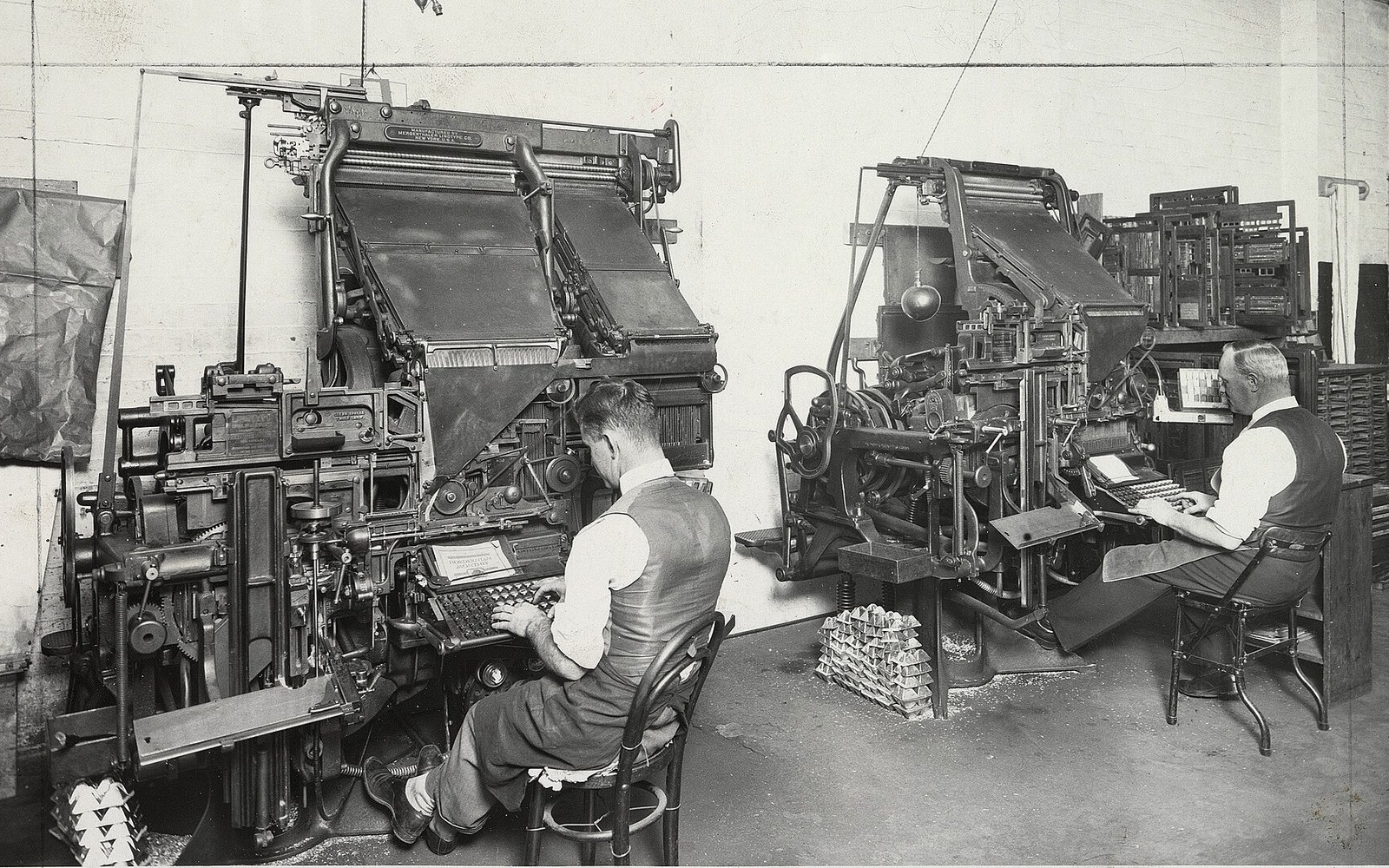
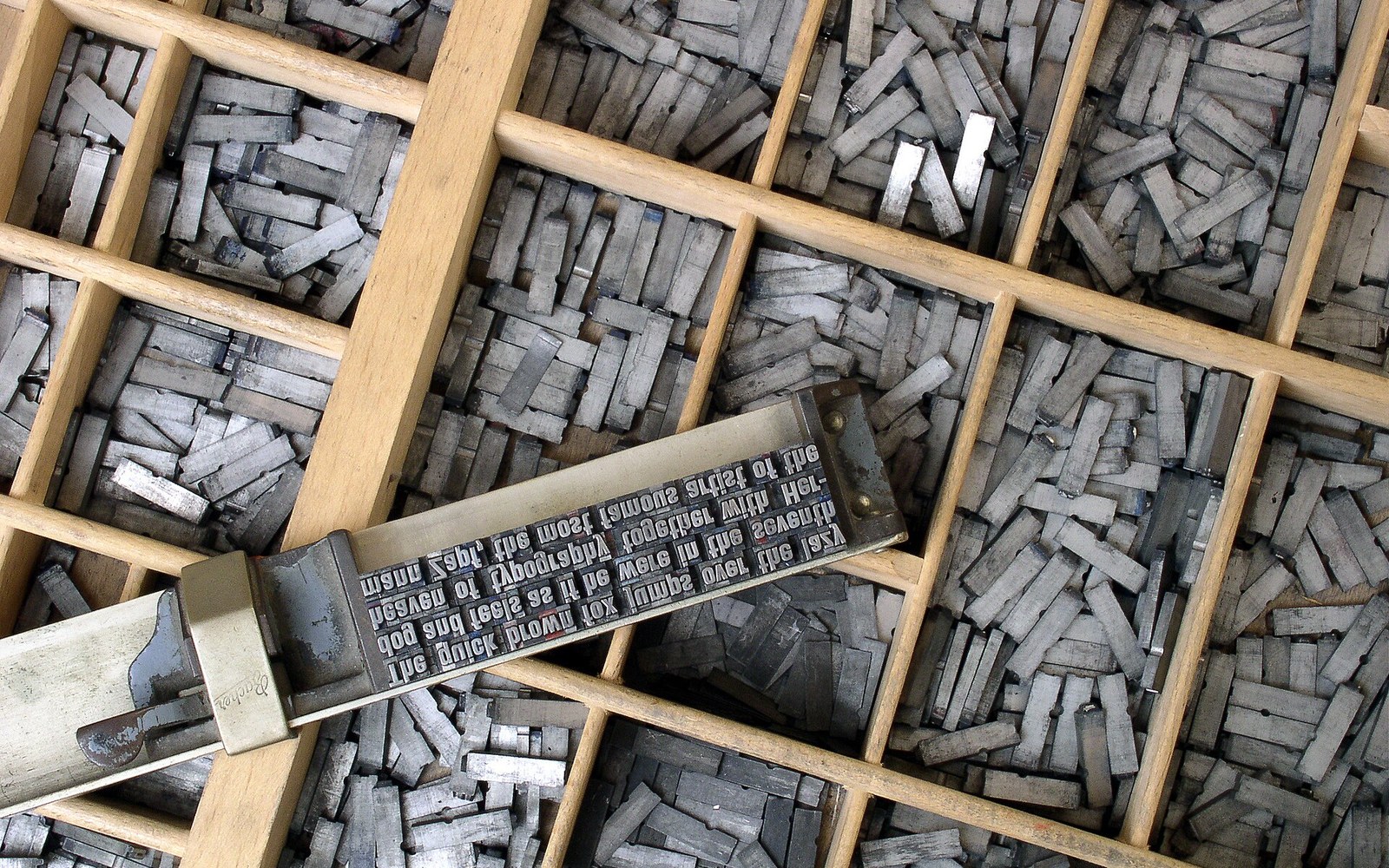
For roughly four centuries after Gutenberg, setting type meant picking individual letters from a case and placing them one by one into a composing stick — a slow, skilled process whose economics governed everything from page width to the price of corrections. Then, in 1886, Ottmar Mergenthaler demonstrated the Linotype machine in New York, and the unit of composition changed. Instead of a letter, it became a line.
The Linotype operator typed at a keyboard, assembling brass matrices — individual letter moulds — into a line. When the line reached the specified measure, the machine justified it automatically by expanding wedge-shaped spacebands between the words, then injected molten lead alloy into the assembled matrices to cast a single metal slug, the full width of the column, in one piece.
That slug — the "line o' type" the machine's name contracted — dropped into a galley with its neighbours. The matrices circulated back to their magazine for re-use. The operator had already moved on to the next line.
The speed gains were immediate and substantial. Where a skilled hand compositor might set around 1,500 to 2,000 ems per hour, a Linotype operator could reach five or six times that rate. Newspapers adopted the technology almost at once: the New York Tribune ran the first commercially set Linotype pages in 1886.
Publishers of books and magazines followed. The Leipzig trade, London's composing rooms, Edinburgh's printing houses — Mergenthaler's machine remade composition everywhere it reached, and Linotype's British operations eventually centred on Broadheath, near Altrincham.
What a Correction Actually Costs
The shift from individual types to cast slugs had one consequence that shaped editorial and publishing practice for generations: correcting a Linotype slug meant recasting the entire line. You could not extract a single wrong letter and replace it, because the line was solid metal. An error on line twelve meant the operator reset line twelve from scratch, cast a new slug, and swapped it into the galley. This was still faster than hand-setting had been, but the cost of correction was now priced by the line rather than by the character.
Publishers and editors adapted their behaviour accordingly. Proofreading became something you did before the type was set, not just after. Authors who revised at proof stage found themselves facing line-by-line correction charges that could accumulate quickly. House style guides grew more insistent about consistency precisely because inconsistency at proof stage was now a measurable expense.
From the record
Key terms
- hot metal
collective term for compositing systems (Linotype and similar) that cast type from molten lead alloy, as distinct from hand-setting or phototypesetting
- slug
the single cast metal line produced by a Linotype machine; the unit that replaced individual types in the galley
- matrix
the brass mould for a single letter, circulated and re-used within the machine
- spaceband
the wedge-shaped spacer that expanded mechanically to justify a Linotype line
- galley
the shallow metal tray in which cast slugs were assembled into columns
The economics of hot metal — the collective name for Linotype and its related machines, all of which worked by casting from molten alloy — pressed toward getting the copy right before it reached the keyboard.
This also affected the visual texture of the page. Because the spacebands that justified each line were set mechanically, Linotype composition could produce uneven word spacing, especially in narrow columns or when long words clustered toward a line-end. The compositor had limited ability to finesse individual lines the way a hand-setter could.
Jan Tschichold, working on the Penguin Composition Rules in 1947, addressed this directly, specifying word-spacing tolerances and directing operators to break words rather than allow rivers of white space — essentially imposing hand-compositor standards on a mechanised process.
From the record
Numbers worth isolating
Hot metal endured in composing rooms well into the 1970s. Phototypesetting, which exposed characters onto film or paper rather than casting them in metal, gradually displaced it from the late 1960s onward, and desktop publishing finished the transition in the 1980s. The slug, the matrix, the molten alloy, the galley of ranked lead lines — all gone. What remained was the logic they had installed: the line as the unit of text, the column measure as a given constraint, the cost calculation behind every late amendment.
Digital composition freed itself from the physical slug but kept many of the conventions the slug had made necessary, because the page layouts and typefaces that surrounded hot metal had been designed around its specific limitations and its specific capacities, and those designs proved durable long after the lead stopped flowing.