Composition · Entry N
Hand setting
Type from the case into a stick, justified by hand with spaces, locked into a forme.
- Section
- V · Composition
- Mark
- Signature N
- Filed by
- Setting the type.
- Next
- Hot metal
 PL. N
PL. NType from the case, letter by letter, and the logic behind every em
For four centuries after Gutenberg, every word printed in Europe passed through a compositor's fingers. Hand setting was not a primitive step on the way to something better; it was a mature, highly codified technology that shaped how books looked and, in turn, how they were read.
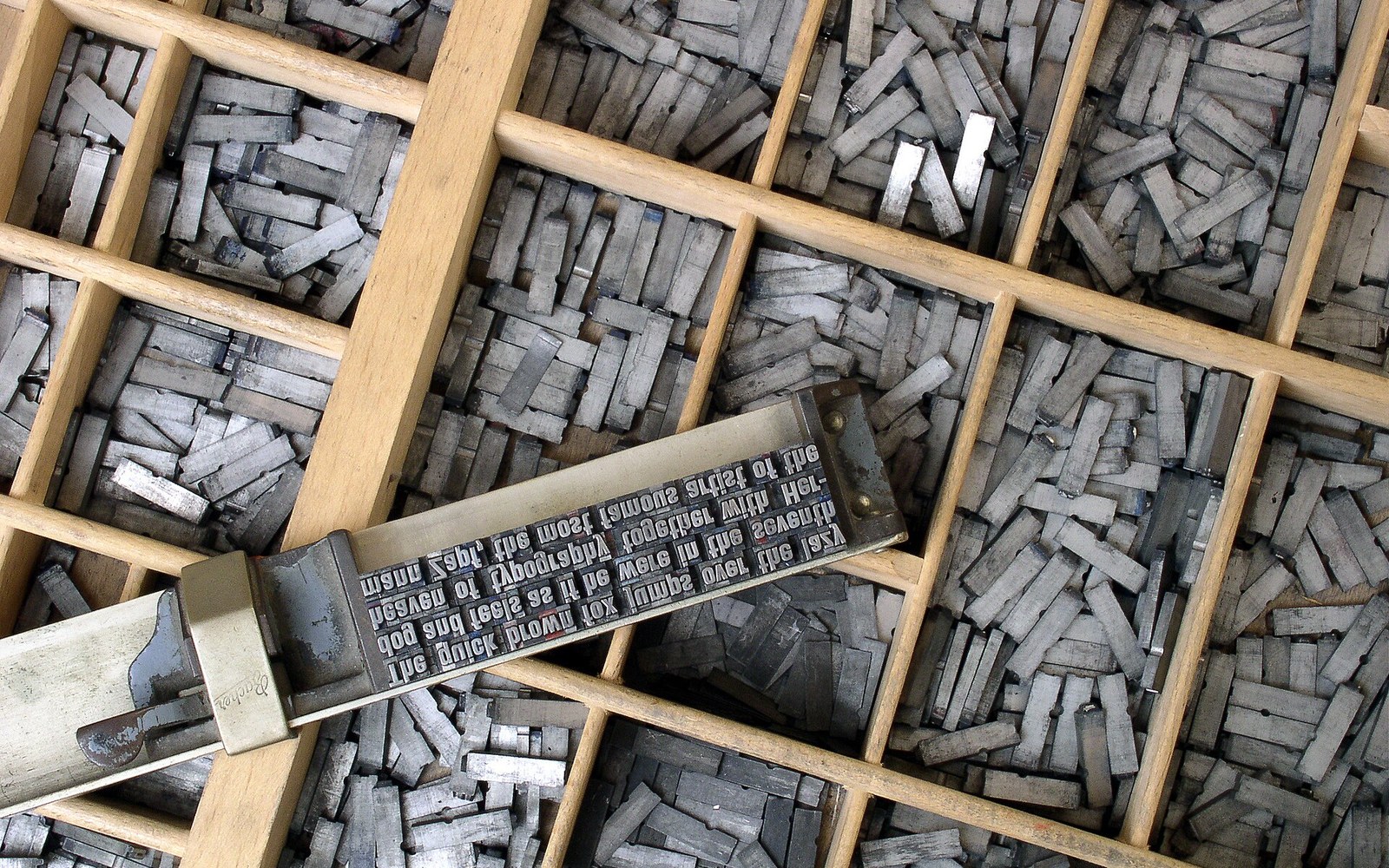
The compositor stood at a pair of angled wooden frames, upper and lower cases, each divided into small compartments holding individual pieces of type cast in a lead alloy. The layout of both cases was standardised by trade custom: capitals and small capitals in the upper case, minuscules in the lower — which is why we still say upper case and lower case for letterforms we have never touched with our hands.
Frequency governed position. The e box sat closest to the hand; the less common z and x sat at the edges. Every compositor, apprenticed young and trained for years, moved without looking.
Type was picked piece by piece and placed into a handheld metal channel called a composing stick, set to the required measure — the line length — in advance. The compositor built words left to right, inserting thin spacing material between them. When the line was nearly full, justification began: the spaces were expanded or slightly compressed by swapping out spacing quads until the line filled the measure exactly, each line ending flush against both margins.
This was judgment, not calculation, and a good compositor worked at it with the same trained eye a proof-reader brings to a sentence.
Completed lines were transferred to a flat metal tray called a galley, where they accumulated until they formed a page. Pages were then arranged, with furniture — non-printing wooden or metal spacing material — to hold them apart, and locked into an iron frame called a forme with wedge-shaped quoins.
The locked forme was lifted, inked, and pressed against the paper. The number of pages in a forme depended on the format: a folio sheet carries two pages per side, a quarto four, an octavo eight, and each layout had to be imposed in the correct order and orientation so the sheet, once printed, folded and trimmed, read correctly.
Errors, corrections, and the true cost of the process
This is where the economics become tangible. Every correction after a forme was locked required the compositor to break it open, remove the wrong letters, reset the line, and re-justify by hand. A single transposed letter might require resetting several words; a deleted sentence could cascade down an entire paragraph, forcing each line to be reset. Compositors were paid by the thousand ems — the em being a unit equal to the point size of the type in use — and corrections, especially those introduced by authors after typesetting began, were charged back.
Publishers were acutely aware of this. Author's corrections were a formal line item, and contracts sometimes capped the author's liberty to revise at proof stage.
From the record
How the process worked — a sequence
- Upper and lower casesangled wooden frames, each compartment holding one sort of type
- Composing stickset to the required line length (measure) before setting begins
- Justificationspacing swapped by hand until the line fills the measure exactly
- Galleyflat tray where completed lines accumulate into a page
- Furniture and quoinsnon-printing spacing material and wedges that lock the forme
- Formethe locked assembly of pages ready for the press
Charles Dickens, who revised heavily in proof throughout his career at Chapman & Hall, was well aware that his deletions and rewordings had a cost downstream. The multi-volume novels circulating through Mudie's Select Library in the mid-nineteenth century ran to hundreds of thousands of ems of composition; the economics of correction were not trivial.
The process remained essentially unchanged from the sixteenth-century Aldine Press to the late nineteenth century, when Ottmar Mergenthaler's Linotype machine, introduced in 1886, began casting whole lines of type at once. The Linotype did not merely speed up setting; it transformed the cost structure of correction entirely, because a corrected line simply melted and was recast rather than being manually dismantled letter by letter.
The hand compositor did not disappear overnight — small printers, jobbing houses, and fine-press operations continued hand setting well into the twentieth century — but the machine ended its dominance over book and newspaper printing within a generation.
What hand setting left behind is more than historical curiosity. The conventions it imposed — the justified line, the standardised measure, the hierarchy of type sizes, the spacing judgments made one line at a time — were absorbed so completely into subsequent typesetting technologies, and then into digital page layout, that we rarely notice them. Every even margin in a printed book is a residue of a compositor justifying a stick by eye and the memory of ten thousand lines before it.
From the record