Circulation · Entry H
Mudie's Select Library
Bulk purchase and lending by the volume kept the three-decker alive long after readers wanted it, because the form suited the lender.
- Section
- III · Circulation
- Mark
- Signature H
- Filed by
- Who actually owned the copy.
- Next
- The three-decker
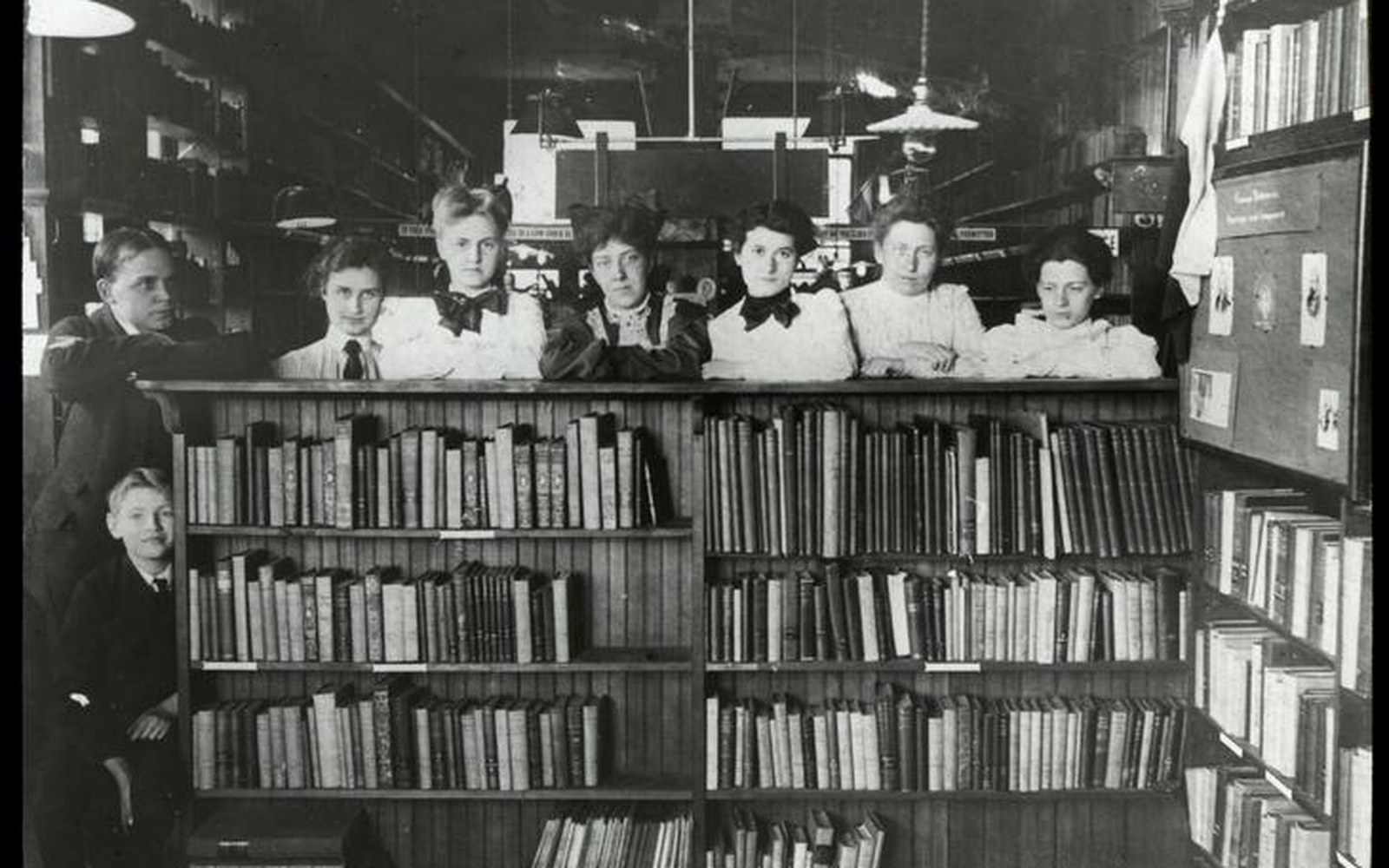 PL. H
PL. HThe subscription library that kept the three-decker on life support — and then, suddenly, didn't.
A Room Full of Volumes
Charles Edward Mudie opened his lending library on New Oxford Street, London, in 1852, and for the next four decades he shaped English fiction more completely than almost any publisher. His instrument was simple: bulk purchase at a discount, lending by the volume for an annual subscription, and a pronounced preference for novels issued in three volumes — the three-decker — at the standard price of a guinea and a half (thirty-one shillings and sixpence).
That standard price matters. A new three-volume novel from a major publisher cost thirty-one shillings and sixpence, a sum that put it beyond the everyday budget of most middle-class readers. Mudie's subscription cost one guinea a year, which entitled the subscriber to borrow one volume at a time. Pay a little more, take more volumes simultaneously. The arithmetic worked neatly in the library's favour: one copy purchased became many loans, and a three-decker extended the transaction across three visits or three concurrent borrowers.
The economics cascaded back through the whole trade. A publisher selling five hundred copies of a new novel to Mudie at a steep trade discount could recoup costs before a single copy reached a retail shelf. Chapman & Hall, Bentley, and Smith, Elder all shaped their lists around what Mudie would buy in quantity.

What Mudie would not buy — fiction that struck him as morally doubtful — simply did not get published in that form, or found a harder commercial road. His taste, exercised without formal authority and never codified, functioned as a de facto censorship, and novelists understood the constraint.
Format as Market Lock-in
The three-decker was not a natural literary unit. Nothing about a novel's length or its internal architecture requires three volumes of roughly equal bulk. Padding was common: scenes extended, episodes multiplied, sub-plots thickened — all to reach the volume count that made the work lending-library viable. The format that suited the lender became the convention the author served.
Mudie purchased in scales that dwarfed individual retail sales. Thousands of copies of a successful title came into New Oxford Street; the great hall filled with shelved volumes that subscribers browsed before handing their tokens to the counter staff. At its peak in the 1860s and 1870s, the library held hundreds of thousands of volumes and served subscribers across the country by rail parcel as well as in person.
From the record
How the money moved
- Annual subscription fee
one guinea for single-volume borrowing at a time; higher tiers for multiple simultaneous volumes
- Standard three-decker price
31s 6d (one guinea and sixpence), far above everyday retail reach
- Publisher's trade discount to Mudie
steep, offset by guaranteed bulk purchase of hundreds of copies per title
- Cheap reprint price
roughly six shillings; deliberately delayed until the library recovered rental income

W. H. Smith ran a rival network of railway-station libraries on similar terms, and together these two institutions locked the three-decker into English publishing with the force of infrastructure.
The mechanism that kept it locked was the publication window. A three-decker at thirty-one shillings and sixpence would yield eventually to a cheap reprint — the yellowback or the single-volume reprint at six shillings — but not until the library had extracted rental income across a long first run. Publishers and Mudie held an informal agreement on timing. The cheap reprint was delayed long enough to protect the library's investment, which meant the library's investment kept the expensive first form alive.
The Collapse
It could not hold indefinitely. By the late 1880s the strain was visible on both sides. Publishers watched the serialisation model prove that readers would follow fiction in cheaper, faster formats. Authors increasingly found the three-volume constraint artistically stifling. The subscription base was not growing as fast as the volume of new titles.
From the record
Chronology
- 1852Mudie opens on New Oxford Street, London
- 1860s–70speak holdings; rail parcel service extends reach nationally
- 1894Mudie's and W. H. Smith withdraw support for three-decker terms; format collapses within the year
In 1894, Mudie's and W. H. Smith jointly informed publishers that they would no longer purchase three-deckers at the old terms — or, effectively, at all. Within months the format was extinct. The announcement did not cause the collapse so much as ratify it; the commercial logic had already corroded. Single-volume novels at six shillings replaced the three-decker almost overnight, publishers' lists reorganised, and the average retail price of a new novel fell sharply.
What the episode reveals is how completely the material conditions of lending — volume count, subscription structure, bulk discount, the rental window — can determine literary form. Mudie did not set out to govern the novel; he set out to lend books at a profit. The novel's shape followed.